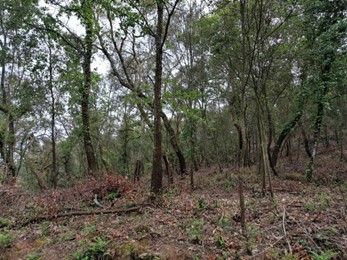
The Montnegre-Corredor is a massif with significant forest continuity and few open spaces, which poses a risk for wildfires. Additionally, although forest management is being carried out in many areas, there is still a significant part that remains unmanaged.
In many cases, this management consists of improvement forest actions that require a significant investment for thinning operations, and the product is scarce, making it a financially unfeasible task without subsidies.
On the other hand, the size of the properties is small, especially in the coastal area, meaning that in order to carry out actions, it is necessary to group different properties together to make the operations economically and logistically viable.
Another challenge in the massif is that most of its forests are considered peri-urban. These areas are used for primary activities (e.g., forestry or livestock) but also contain residential zones and serve as recreational spaces for residents of nearby cities. This creates a challenge for the compatibility of land uses, the logistics of forest management, and a clash of perceptions regarding the activities taking place there.
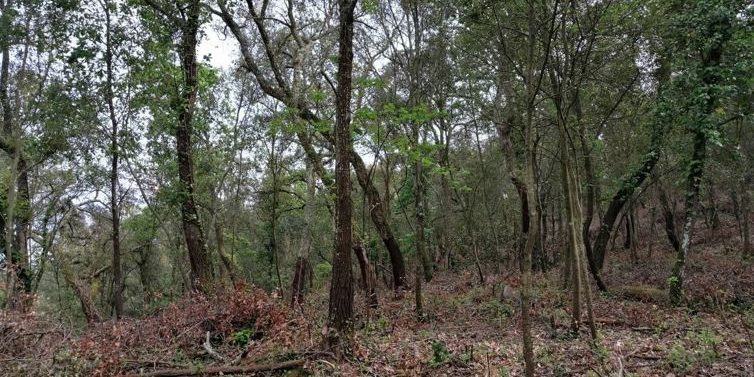
As a result, forest management is limited, and in some cases, we encounter excessively dense forests with high amounts of fuel and simple structure and composition, making them more vulnerable to disturbances such as wildfires, droughts, and pests, which are increasingly frequent in the massif.
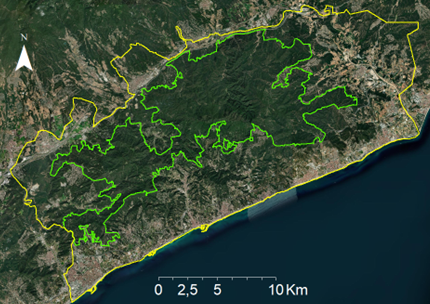
For this reason, developing a forest management approach that enhances the resistance and resilience of these forests is one of the key goals that the Association of Owners and the Montnegre and Corredor Forest Group aim to promote and implement.
This management has the following characteristics:
- Increase in structural complexity and promotion of continuous cover: Irregular or semi-regular management to ensure continuous cover, with selective thinning to control regrowth and ensure soil cover.
- Increase in species complexity: Promote the mixing of existing species or enhance diversity through enrichment planting.
- Mild, frequent, and targeted interventions: Extraction of 25% of basal area every 10-15 years (once 25 m²/ha of basal area is achieved). These cuts allow for: faster recovery of growth after cutting, maintenance of the forest environment, control of shrub species development, and reduced thinning costs.
- Close-to-nature criteria: Select the most valuable trees for biodiversity, seed production, and timber production, removing 1-2 competitors at the canopy level.
- Criteria for maintaining and promoting biodiversity.
- Valorization and diversification of products: Management of forest products with the goal of maximizing their quality for uses such as cabinetmaking or carpentry.